AI in Branding: What It Actually Does for Founders
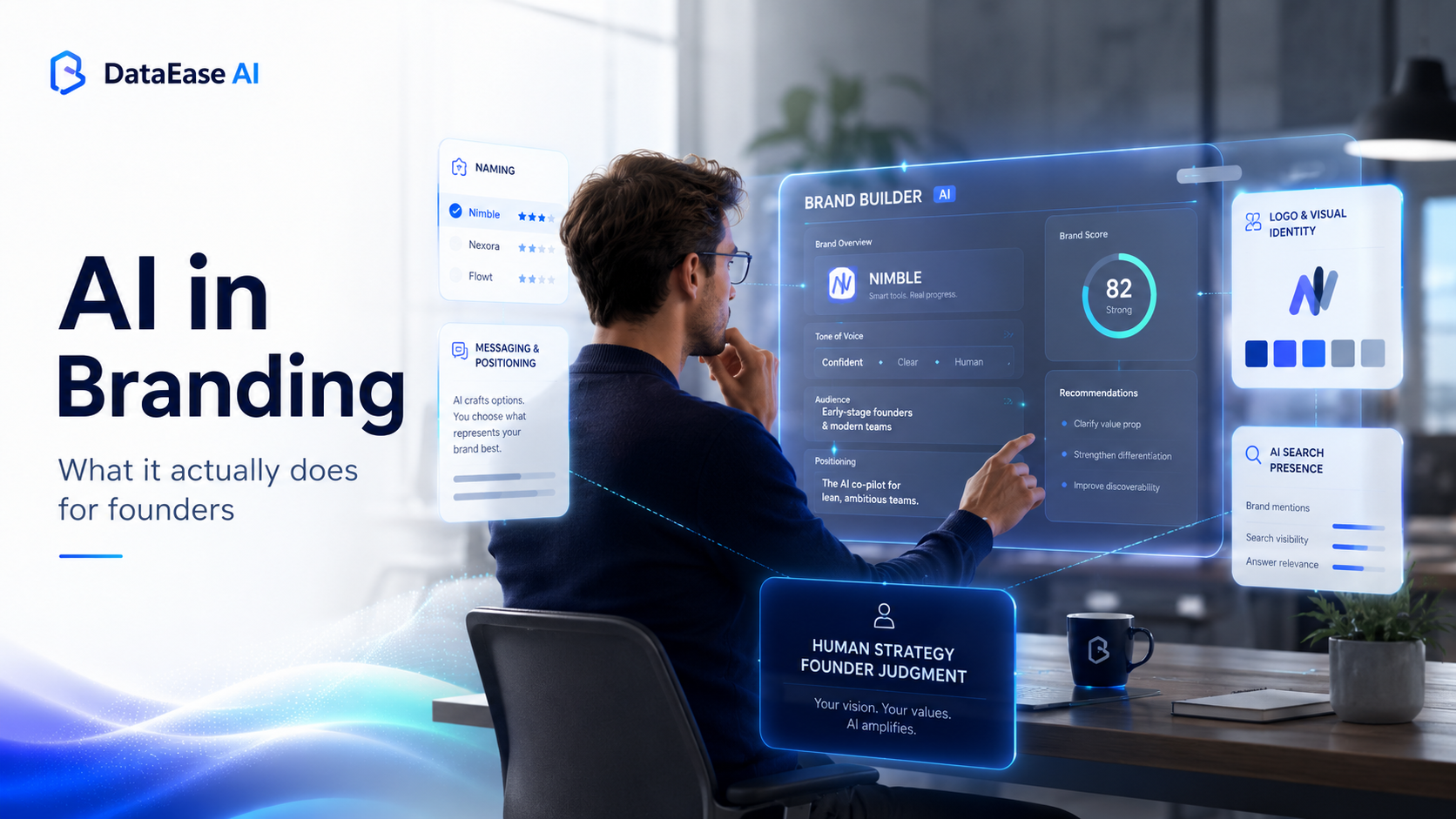
Ask an AI tool for ten brand names and you will have them in about four seconds. Generating options was never the hard part. Knowing which ones are any good, and what to do once you have picked one, is. That is what AI in branding is really about: using AI to do the work of building a brand, from names and logos to messaging, visual consistency, and a read on how AI engines see you, while you keep the judgment.
We have started several companies, and in every one of them branding began as something we did ourselves, late at night, with no budget and no design team. So when founders ask us where AI and branding actually fit together, we answer from the trenches rather than from a pitch deck. AI changed how fast we can move through the branding work. It did not change who has to make the hard calls.
What does AI in branding actually mean?
Branding has always been two different jobs wearing one word. There is the strategy - who you serve, what you stand for, what you refuse to be - and there is the craft - the name, the logo, the colors, the words on the page. AI in branding is overwhelmingly about the second job.
That distinction matters because most of the disappointment we see with AI branding comes from founders expecting it to do the first job. It will happily generate a hundred taglines. It cannot tell you which one is true. The founders who get the most out of AI and branding are the ones who bring a clear point of view and use AI to execute it faster, not the ones hoping AI will hand them a point of view they never developed.
Where does AI in branding actually help?
Here is where we reach for AI on real branding work, and where it earns its place.
Naming
Naming is the classic AI-and-branding use case because it is a volume problem. You need to see a lot of candidates to find the few that are distinctive, pronounceable, and not already taken. AI is excellent at generating that volume and decent at riffing on a direction you give it. It is poor at judging which name is ownable, so treat its output as raw material, then run the shortlist through trademark and domain checks yourself.
Logo and visual identity
AI logo tools have gone from a joke to actually usable in about two years. For an early-stage company that needs a clean, credible mark to ship a landing page this week, they are more than good enough. Our own free AI Logo Generator exists for exactly that moment. Where AI still struggles is consistency - holding the same identity across every touchpoint - which is a systems problem more than a drawing problem.
Messaging and positioning
AI is a strong sparring partner for messaging. It will rewrite your value proposition ten ways, find the jargon you have gone blind to, and draft the FAQ you keep putting off. What it will not do is decide your positioning. We use it to pressure-test wording once we know what we are trying to say, never to discover what we are trying to say.
Showing up in AI answers
This is the newest and, for us, the most important place AI and branding meet. Buyers now ask ChatGPT, Perplexity, and Gemini for recommendations, and those engines either name your brand or they do not. Getting named is a branding problem now, not just an SEO one, and it depends on having one consistent, machine-legible story about who you are. We wrote a full guide on AI in search engines if you want the bigger picture.
Where does AI in branding fall short?
We are bullish on AI in branding, so it is worth being honest about the ceiling. AI defaults to the average. On our last company we asked for naming options and got back a tidy list - FlowSync, DataNest, BrandWise - with a matching tagline, "Smart tools for modern teams." Every one was clean, pronounceable, and completely forgettable. Nothing was wrong with them, which was exactly the problem. AI is trained on what already exists, so left unguided it hands you a brand that looks and sounds like everyone else in your category. That is the opposite of what branding is for.
It also cannot feel taste. It does not know that your category is drowning in the same three shades of blue, or that the safe tagline is the forgettable one. And it cannot make the strategic trade-offs - choosing who to alienate, what to leave out - that give a brand an edge. Those remain stubbornly human, and we think they will for a long time.
How we use AI in branding at DataEase AI
We build the tools we wished we had as founders doing our own branding, and the pattern across all of them is the same: AI does the labor, you keep the judgment. The free Brand Analyzer scores your brand across seven pillars plus an AI visibility check, so you can see how AI engines are likely to treat you, and Brand Intelligence tracks your Brand Presence Score over time and recommends the next fix, tying branding back into the wider discipline of Brand Presence Intelligence.
From tools to specialized agents
The bigger shift we are building toward is moving the recurring, manual work off the founder's plate entirely. A lot of brand and marketing upkeep used to be something we did by hand every week - researching blog topics, doing keyword research, writing the posts and pages, submitting to directories, and chasing down SEO fixes. In DataEase AI, that work is increasingly handled by specialized AI agents, each one good at a single job:
- An agent that researches blog topics worth writing - the questions your buyers actually ask AI engines in your category.
- An agent that runs keyword research and prioritizes the terms you can realistically win.
- An agent that writes the blog posts and landing pages themselves, structured to be cited by AI engines.
- An agent that handles directory submissions and finds relevant partner and backlink sites to reach out to.
- An agent that audits and fixes the SEO and AI-readiness issues holding your pages back, from schema and metadata to internal links.
You can run each agent on demand or let it run on a schedule, and you stay in the loop to approve the work. The principle is the same as the rest of AI in branding: the agents do the legwork, you keep the judgment.
None of these decide your brand for you. They remove the grunt work so a founder with a clear point of view can move as fast as a funded team. If you want the one-line definition to take away, our AI in branding glossary entry keeps it short.
Frequently asked questions
What is AI in branding?
AI in branding is using AI tools to do the work of building a brand: generating names and logos, drafting and pressure-testing messaging, and keeping visual identity consistent. It also reviews your website, visitors, crawl data, and how AI engines describe you, analyzes those signals, and recommends the specific action items to take to improve your branding and brand presence. It speeds up the craft, but the strategy and judgment still belong to the founder.
Can AI build a brand by itself?
No, and you should not want it to. AI handles the execution - generating names and logos, drafting messaging, checking consistency, and flagging what to fix - but it cannot choose who you serve, what you stand against, or the trade-offs that make a brand distinctive. Left to decide on its own, AI defaults to the category average, which is the opposite of what branding is for. The direction stays with the founder.
What are the best AI branding tools for a startup?
The most useful AI branding tools for a startup do not just generate assets - they tell you what to fix and then fix it. DataEase AI pairs a free Brand Analyzer with specialized AI agents that surface SEO, AEO, and GEO insights, track how ChatGPT, Perplexity, and Gemini describe you, and turn it all into prioritized action items across the three Brand Presence Intelligence components - then draft the pages to close the gaps.
How does AI branding affect whether AI search engines recommend me?
Hugely. When someone asks ChatGPT, Perplexity, or Gemini for the best option in a category, they name the brands they can resolve into one confident, well-documented entity. A consistent brand - one clear description everywhere, backed by schema and third-party mentions - is far easier to resolve, so it gets named more often. The free Brand Analyzer does not query the models live; it scores the static signals those engines look for when deciding whom to cite, so you can see whether you are set up to be recommended.
See how AI describes your brand
Run a free Brand Analyzer scan to score your brand across seven pillars plus AI visibility, and see whether ChatGPT, Perplexity, Gemini, and Google AI Overviews are set up to recommend you.
Analyze your brand free